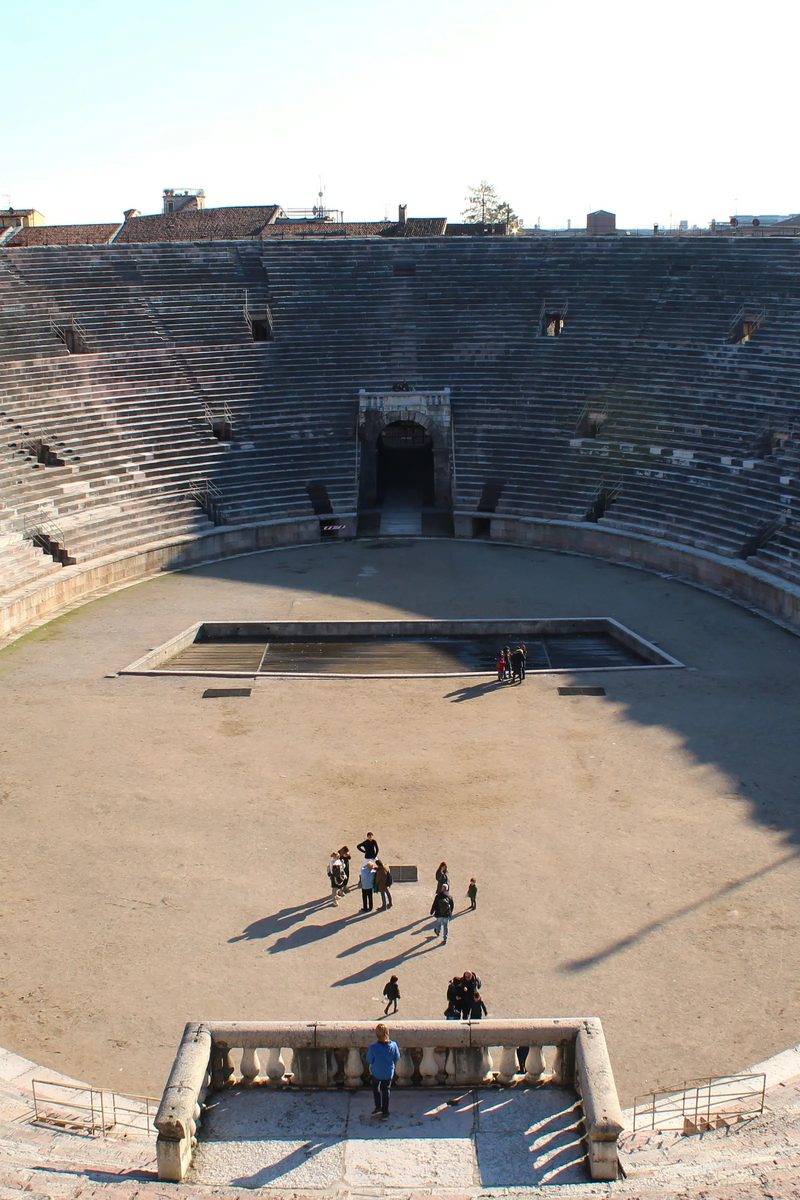
The Arena di Verona — the elliptical Roman amphitheatre in Piazza Bra, its pink-and-white limestone tiers rising against a clear Veronese sky

Step inside a Roman amphitheatre built nearly 2,000 years ago

Timed daytime entry to walk the arena floor and climb the surviving stone tiers of the Arena di Verona — your slot reserved.

See ticket options
  • c. 30 AD Built in the 1st century, under Rome
  • ~30,000 Original Roman seating capacity
  • Best-preserved One of the world's finest Roman amphitheatres
  • UNESCO 2000 Verona inscribed as World Heritage

Arena di Verona tickets — timed daytime entry

Full-price adult daytime entry to the Roman amphitheatre, with a timed slot reserved for you. Choose your date and entry window, and we secure your official admission and send a QR ticket to your inbox — no ticket-office queue on arrival.

  • Book in your languageYour currency, final price.
  • Pro tips includedBest slots, the opera-season caveat, the view most miss.
  • Ready before you flyQR ticket, ready in your inbox.
  • 24/7 human supportReal people, instant answers — any hour, any time zone.
4.8 from 112 verified travellers
Charlotte F.
Manchester, England
“We booked a 10:00 daytime slot, scanned the QR at the gate, and had the arena floor almost to ourselves. Climbing to the top tier and looking down over the whole amphitheatre was the highlight of our Verona day.”
March 2026
Lukas H.
Vienna, Austria
“Honestly could not work out how to buy a plain daytime ticket — every search led to opera tickets. This made it simple, in English, and the ticket was in my inbox in minutes.”
February 2026
Miguel R.
Mexico City, Mexico
“Straightforward booking and a genuinely awe-inspiring monument. The short audio history they sent beforehand made the visit much richer — I knew what I was looking at.”
February 2026

5-minute audio guide

Your Arena di Verona 5-minute guide

Hand-written, narrated by a heritage host, sent free with every ticket. Five minutes of background before you arrive — how the amphitheatre was built around 30 AD, what the 1117 earthquake left behind, and what to look for as you walk the arena floor and climb the tiers.

Included with your booking — your full guide arrives with your ticket.Get your guide
  • Why the Arena was built outside the Roman walls around 30 AD
  • The pink-and-white Valpolicella limestone and how to spot the dichromatism
  • The 1117 earthquake and the surviving four-arch Ala
  • Why this amphitheatre never fell out of use — from gladiators to opera since 1913

Included free with every ticket. No app, no download — plays in any browser.

About Arena di Verona

The Arena di Verona is a Roman amphitheatre in the heart of Verona, built around 30 AD — in the 1st century, when the town was a thriving Roman colony. It was raised just outside the original city walls, and only in 265 AD, when the emperor Gallienus extended the walls, did the amphitheatre become part of the city it now anchors. Constructed from the pink-and-white limestone of the nearby Valpolicella hills, the elliptical structure could seat roughly 30,000 spectators, who came to watch gladiatorial contests. It is the third-largest surviving Roman amphitheatre, after the Colosseum in Rome and the amphitheatre at ancient Capua, and one of the best-preserved anywhere in the world.

The Arena stands in Piazza Bra, Verona's grandest square, and dominates it completely — a full ring of stone tiers open to the sky. An exceptionally violent earthquake on 3 January 1117 destroyed almost the whole of the outer ring; what survives of that monumental outer facade is a four-arch fragment known as the Ala (the 'Wing'), which still rises above the surrounding wall and hints at how tall the original exterior once stood. The inner ring of arches and the tiered seating, remarkably, came through the centuries largely intact, which is why the interior still reads so clearly as a working Roman arena.

Verona itself was inscribed by UNESCO as a World Heritage Site in 2000, recognised as an outstanding example of a town that developed continuously over two thousand years, carrying artistic elements of the highest quality from Roman, medieval, and Renaissance periods. The Arena is the city's defining monument and a centrepiece of that inscription — a rare survivor of the Roman world that has never fallen out of use.

That continuity of use is the Arena's most remarkable feature. Where most Roman amphitheatres are ruins, this one still fills. Since 1913 it has hosted a celebrated summer opera festival, and its acoustics and vast tiered seating have made it a stage for more than a century. A daytime visit lets you have the monument on its own terms — walking the arena floor, climbing the ancient steps, and standing where 30,000 Romans once sat, long before the evening crowds and stage lights arrive.
Practical information

Opening hours
Tuesday–Sunday 09:00–19:00 (last entry shortly before closing); Monday 13:30–19:30. Hours are shorter during the summer opera festival (roughly mid-June to early September): on performance days the Arena closes to daytime visitors in the early afternoon so the stage can be prepared, and morning-only visiting is common. Hours are also reduced in winter. Confirm the exact window for your date when you book — we do this for you.
Entrance
The public entrance is on Piazza Bra, at the foot of the amphitheatre. Your timed slot admits you through the operator's gates; arrive a few minutes before your window.
Address
Piazza Bra, 37121 Verona, Italy. The Arena stands in the centre of the square.
Getting there
From Verona Porta Nuova rail station: a 15–20 minute walk north along Corso Porta Nuova straight to Piazza Bra, or a 5-minute ride on city bus 11, 12, or 13 to the Arena stop. The historic centre is pedestrian-only and inside Verona's limited-traffic zone (ZTL) — there is no driving access to the square.
Accessibility
Piazza Bra and the ground level around the Arena are step-free. The interior is an ancient monument: the tiered seating (the cavea) is reached by original stone steps that are steep, uneven, and worn, and there is no lift to the upper tiers. Wheelchair users can access the arena floor level via the operator's assisted route — contact Musei Civici di Verona in advance to arrange support.
Bag policy
Large backpacks and bulky bags are restricted; small bags are permitted. Security checks apply at the gate, especially during the opera season.
Photography
Personal photography is permitted throughout the daytime visit. The arena floor, the tiered stone seating, and the surviving Ala outer-ring fragment are the classic shots. During the opera season the arena floor may hold stage sets and tiered performance seating.

About our service

Arena di Verona Tickets is an independent booking service operated for international visitors. We facilitate timed daytime-entry tickets to the Roman amphitheatre, sourced from Musei Civici di Verona, the official Comune di Verona operator. We sell one full-price adult daytime ticket; reduced and free operator categories should be booked direct (see the FAQ). We do not sell tickets to the Arena Opera Festival, which is a separate event run by Fondazione Arena. Our concierge service fee is included in the displayed price.

Frequently asked

What exactly am I booking — is this an opera ticket?

No. This is a timed daytime-entry ticket to visit the Roman amphitheatre as a monument: you walk the arena floor, climb the ancient stone tiers, and see the surviving Ala outer-ring fragment. It is not a ticket to the Arena Opera Festival. The opera is a separate evening event run by Fondazione Arena and sold on their own website — we do not sell it and it is not included here.

How does entry work?

You choose your date and an entry time slot at checkout. We book the matching official daytime-entry ticket with Musei Civici di Verona and email you a QR ticket. On the day, arrive a few minutes before your slot at the Piazza Bra entrance and scan in — there is no ticket-office queue to stand in. The daytime Arena does not sell out the way a timed museum can, so this is about certainty and convenience, not scarcity: your date and window are locked in and booked in English.

What will I see inside?

The full interior of a nearly 2,000-year-old Roman amphitheatre — the open elliptical arena floor where gladiators once fought, the concentric rings of pink-and-white limestone seating (the cavea) that once held around 30,000 spectators, and the four-arch Ala, the only surviving piece of the original monumental outer ring after the 1117 earthquake. From the upper tiers you look down over the whole arena and out across Piazza Bra and the rooftops of Verona.

Visiting during the opera season — what should I know?

We want to be straight about this. During the summer opera festival (roughly mid-June to early September), daytime visiting is more restricted. Hours are shorter — often mornings only — and on performance days the Arena closes to daytime visitors in the early afternoon so the stage can be set up. Just as importantly, the arena floor is not empty in this period: it holds the opera stage, sets, and tiered performance seating, so you will not see the 'clean', bare Roman amphitheatre. You still walk the tiers and take in the scale and the stone, but if seeing the empty arena floor matters to you, visit outside the festival months (roughly October to May). We confirm the exact daytime window for your chosen date when we book.

I'm a senior, under 18, a student, disabled, or hold a VeronaCard — do I need this ticket?

Probably not, and we don't want you to overpay. The operator offers reduced and free daytime categories that we do not resell: under-18s and disabled visitors with a carer enter free, EU citizens aged 18–25 pay a reduced rate, over-65s pay a reduced senior rate, and VeronaCard holders are covered by their card. If you fall into one of these, book direct with Musei Civici di Verona or enter on your card. We handle the full-price adult (18+) daytime ticket — the one category most international visitors need.

How does your concierge service work?

The daytime Arena ticket is genuinely hard to find — it sits behind the far more visible opera festival in search results, and the operator's own checkout is on an Italian-only civic-museums platform with timed slots. We surface it, book it for you in plain English, take payment in your own currency, and send a ready-to-scan QR ticket to your inbox. If anything changes with your date, our team is on call around the clock to help. Our service fee is included in the price you see — no surprises at checkout.

How do I get to the Arena di Verona?

The Arena stands in Piazza Bra in the centre of Verona. From Verona Porta Nuova railway station it is a 15–20 minute walk north along Corso Porta Nuova, straight into Piazza Bra, or a 5-minute ride on city bus 11, 12, or 13 to the Arena stop. The historic centre is a pedestrian-only limited-traffic zone (ZTL), so there is no driving to the square — drivers should use a peripheral car park and walk in. Verona Porta Nuova has direct fast trains to Venice (about 60 min), Milan (about 75 min), and Bologna (about 45 min), making the Arena an easy day trip.

How long does a daytime visit take?

Most visitors spend 45 minutes to an hour and a half inside — long enough to walk the arena floor, climb to the upper tiers for the view, and take in the Ala and the information around the interior. It is self-guided and unhurried; there is no fixed route.

Can I change my date?

Tickets are issued for a specific date. If your plans change, reply to your confirmation email as early as possible and we will help where we can — we cannot always guarantee a new slot, but we will rebook you the moment a new slot opens in the operator's calendar.

Is the Arena wheelchair-accessible?

Partially. Piazza Bra and the ground level are step-free, but the tiered seating inside is reached by steep, uneven original Roman stone steps with no lift. Wheelchair users can reach the arena floor level via the operator's assisted route — contact Musei Civici di Verona in advance to arrange it.